


 At a glance
<p><strong>Timber tongue-and-groove cladding</strong> offers a traditional finish with natural wood grain, interlocking boards and good durability. <strong>MDF wall panelling kits</strong> provide a smooth, uniform surface suited to contemporary styles such as Shaker and Jacobean. The right choice depends on your preferred finish, installation requirements, moisture exposure and the character you want to add to your space.</p>
<p>Whilst different interior design trends come and go, adding decorative wall panelling to rooms is a choice that never really goes out of style. With the right wall panelling, you can quickly add character and depth to any room in your home. Whether you are updating a hallway, creating a bedroom feature wall, or modernising a living space, the two most popular routes for UK homeowners and tradespeople are traditional timber tongue-and-groove cladding and pre-cut MDF wall panelling kits. Both of these do a great job for changing the look of a plain plastered wall, but the way to install them and the final finish you get differs massively between the two.</p>
<p><strong>Tongue-and-Groove vs MDF Wall Panelling Kit - Key Summary</strong></p>
<ul>
<li>Timber tongue-and-groove (T&G) cladding interlocks seamlessly to create classic vertical or horizontal plank walls with natural wood grain and superior impact resistance. Explore Harlow Bros' <a href="https://www.harlowbros.co.uk/shop/timber-joinery/cladding/internal-timber-cladding">internal timber cladding</a>.</li>
<li>MDF wall panelling kits use precision-cut strips to form geometric styles such as Shaker, Jacobean, or slatted panelling with a smooth, knot-free surface ready for painting. Browse the range of <a href="https://www.harlowbros.co.uk/shop/timber-joinery/cladding/wall-panel-kits">MDF and timber wall panel kits</a>.</li>
<li>Solid timber cladding copes far better with humidity and minor knocks than standard MDF, unless you upgrade to moisture-resistant (MR) MDF.</li>
<li>MDF requires minimal sanding on flat faces but careful sealing on cut edges, whereas timber T&G needs knot priming before painting.</li>
</ul>
<p><strong>What is Tongue-and-Groove Cladding?</strong></p>
<p>Typically made from Scandinavian redwood or whitewood, it is made of solid softwood boards. They're milled with a tongue along one edge, which protrudes so that it can fit into the matching groove along the other edge of the next board. They slot together to form an interlocked timber surface without any visible fixings.</p>
<p>One of the best things about this set-up is that it allows for wood to contract and expand as room temperature shifts with the seasons.</p>
<p>Harlow Bros stocks a selection of <a href="https://www.harlowbros.co.uk/shop/timber-joinery/cladding/internal-timber-cladding">tongue-and-groove timber cladding</a> in different profiles and timber options to help achieve a traditional or contemporary finish.</p>
<p><strong>What are MDF Wall Panelling Kits?</strong></p>
<p>Medium-Density Fibreboard (MDF) wall panelling kits are packs of pre-cut, factory-machined strips designed to be bonded directly onto an existing wall in a grid or slat layout. Rather than covering the entire wall surface, traditional Shaker or Jacobean kits use your existing plastered wall as the recessed backing, creating crisp shadow lines and clean architectural symmetry. As MDF is an engineered sheet material, every strip is uniform in thickness, completely free from knots or grain movement, and arrives ready to prime and paint.</p>
<p>Take a look at Harlow Bros' range of <a href="https://www.harlowbros.co.uk/shop/timber-joinery/cladding/wall-panel-kits">MDF wall panelling kits</a> for different styles and decorative finishes.</p>
<p><strong>Comparing the Finish</strong></p>
<p>Whether you go for tongue-and-groove cladding or MDF wall panelling depends massively on what finish you are aiming for at the end of your project and how you're able to install the decorative wall.</p>
<p><strong>The Look –</strong> If you're looking for a finish that offers organic warmth and a visible wood texture, then tongue-and-groove is a great choice. With W-groove shadow lines, the texture of the wood shows up under a coat of paint, for a natural finish. However, if you want a contemporary finish that is ultra-smooth, MDF kits are the way to go. MDF allows for razor-sharp edges and no natural grain showing through.</p>
<p><strong>Preparation –</strong> Solid pine tongue-and-groove requires a coat of knotting solution over any resinous knots before priming to stop yellow bleed-through over time. Whereas MDF needs very little sanding, though cut ends soak up paint and must be sealed with MDF primer first. Harlow Bros stocks a range of <a href="https://www.harlowbros.co.uk/shop/fixings-adhesives-treatments/treatments-varnishes-oils-stains/paints-primers">paints, primers and MDF sealers</a> to help prepare surfaces for painting.</p>
<p><strong>Moisture Resistance –</strong> Out of the two choices, MDF is the less moisture-resistant option. If you are planning to panel a room with lots of moisture, then specifying that you want moisture-resistant (MR) MDF is essential. If you're planning a wall panel in a room likely to be busy with people traffic, then real timber stands up well to knocks from shoes, bags, and furniture.</p>
<p><strong>Which is Easier to Fit?</strong></p>
<p>For a straightforward weekend DIY project on a flat wall, MDF panelling kits are generally quicker to install. Most kits can be fixed using high-grab adhesive and a spirit level, with minimal cutting required if your wall dimensions match the pack layout. Tongue-and-groove cladding takes a little more carpentry—especially if you are fixing timber battens to uneven walls and secret-nailing through the tongues.</p>
<p>Whichever style you choose, acclimatising your materials in the room for 48 hours before fitting prevents gaps or movement once installed. For the sharpest professional finish, run a neat bead of flexible decorator's caulk along all internal joints and skirting junctions before applying two coats of durable interior eggshell or satin paint. Harlow Bros also stocks a range of <a href="https://www.harlowbros.co.uk/shop/fixings-adhesives-treatments">grab adhesives and fixing products</a> to help with installation.</p>
Continue your project
Products relevant to this guide
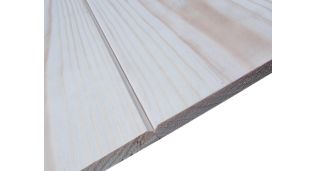
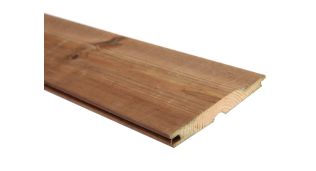
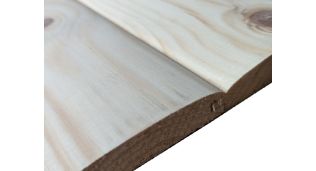
These are relevant examples, not a best-seller ranking. Confirm the right specification for your project before ordering.
Common questions
Frequently asked questions
Which gives a smoother painted finish, MDF or timber tongue-and-groove?
MDF wall panelling kits give the smoothest, most uniform painted finish because the engineered board has no natural wood grain, knots, or resin pockets. Timber tongue-and-groove cladding will always retain a subtle natural grain texture and V-groove join lines, which suits traditional or rustic interiors.
Can I use MDF panelling in a bathroom or downstairs cloakroom?
Only if you use moisture-resistant (MR) MDF and seal all cut edges thoroughly with primer before painting. Standard MDF will absorb steam and swell in humid rooms, whereas properly sealed MR MDF or solid timber tongue-and-groove performs more reliably. Always check the manufacturer's suitability guidance for the intended environment.
Which is better for covering uneven or damaged walls?
Tongue-and-groove cladding is generally better for uneven walls. Because T&G boards cover the entire wall surface—and can be mounted over timber battens—they can help hide cracked, bumpy, or poorly plastered walls. MDF grid kits rely on your existing wall surface showing between the strips, so any wall imperfections may remain visible.